Here’s a pattern I keep seeing in teams building with LLMs.
An engineering team adopts AI. They pick a frontier model — Opus, GPT-5.4, whatever’s top of the leaderboard. It works. They ship. Every task runs through it. JSON extraction. Summarization. Classification. Multi-step reasoning. All of it.
The problem wasn’t a wrong choice. It was no choice at all.
If you’ve been in cloud long enough, you recognize this. It’s 2012 again. Running an m5.16xlarge for a cron job. The bill arrives. You feel it.
We built entire disciplines to fix that — FinOps, auto-scaling, reserved capacity, right-sizing. We learned that cost wasn’t a finance problem. It was an architecture problem.
The AI industry is relearning the same lesson with a different currency. Tokens.
What Models Actually Cost
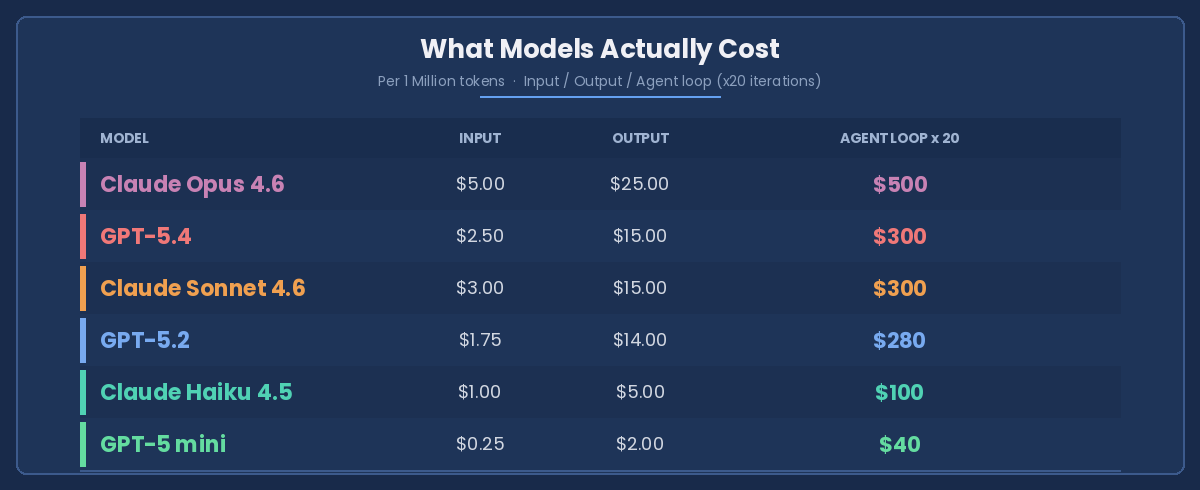
That last column is the one nobody looks at.
In agentic systems, prompts don’t fire once. They fire in cycles — reflection steps, tool calls, retries, self-correction. A single model choice doesn’t add cost. It compounds it.
Opus running 20 agent iterations: $500. GPT-5 mini doing the same loop: $40. That’s a 12x difference. Even mid-tier models like Sonnet and GPT-5.2 at $300 per loop are 7x what GPT-5 mini costs — for tasks where the lighter model handles the job just fine.
And cost isn’t the only thing compounding. Latency does too. Frontier models are slower. In real-time pipelines, that slowness cascades through every downstream step.
The Model Hierarchy
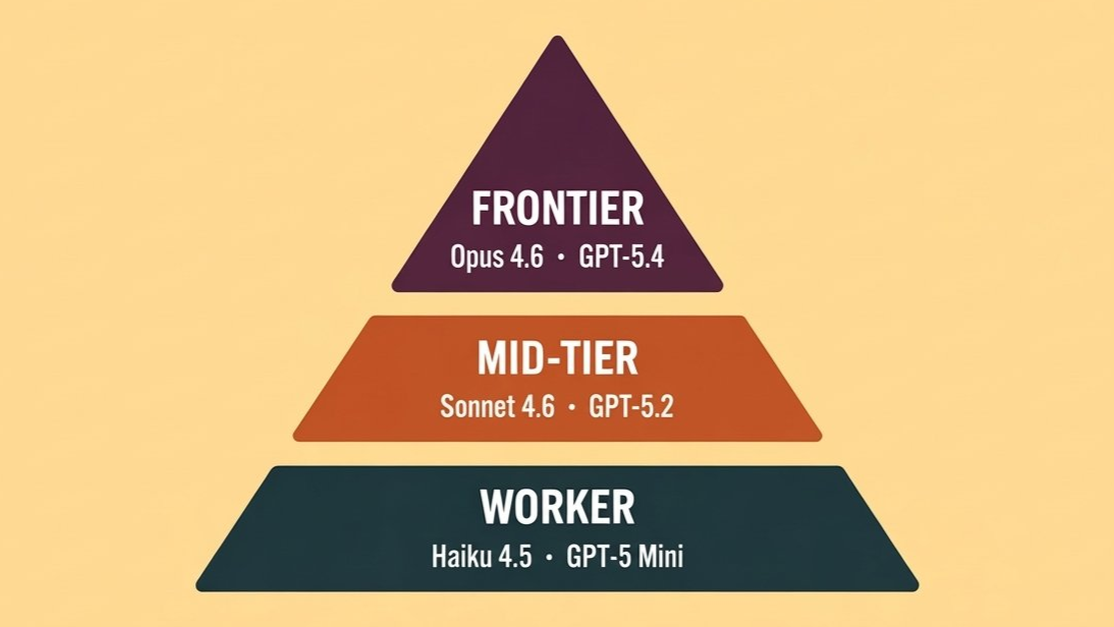
Not every task earns your smartest model. Think of it as a pyramid.
Tier 1 — Frontier (Opus 4.6, GPT-5.4) Complex reasoning, ambiguous problems, final synthesis. Use intentionally, not by default.
Tier 2 — Mid-Tier (Sonnet 4.6, GPT-5.2) Most production workloads. Code generation, structured analysis, drafting. This is your default.
Tier 3 — Worker (Haiku 4.5, GPT-5 mini) High-volume, deterministic tasks. Classification, extraction, routing, subagent I/O. Scale here.
Below the pyramid — Plain Code Anything deterministic, rules-based, or latency-critical. Date parsing. Regex. Validation. Don’t pay a model to do what a function does in microseconds for free.
The rule: start at the bottom. Escalate only when the task demands it.
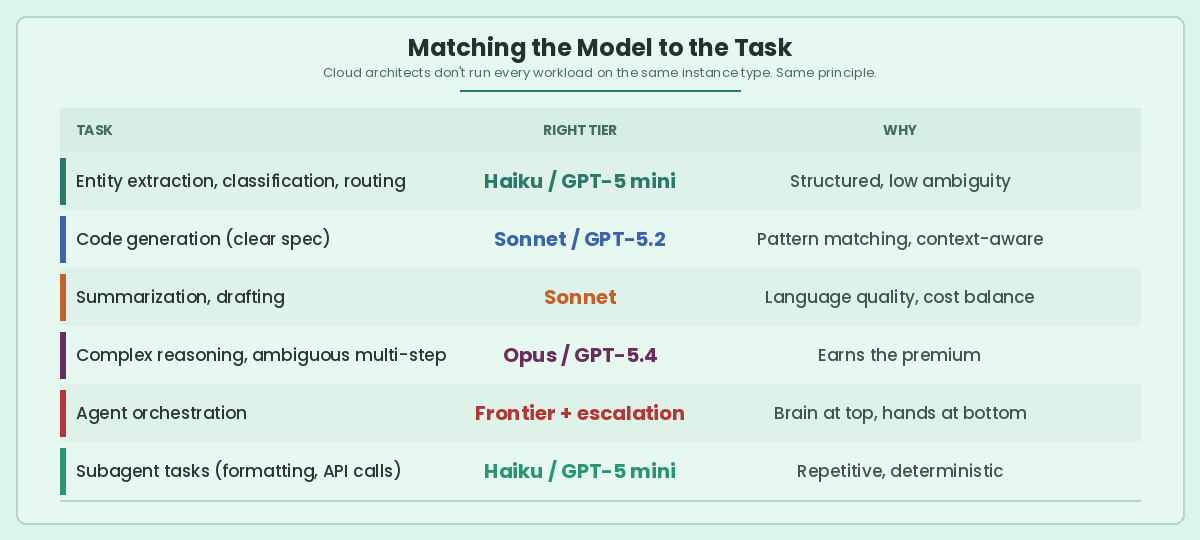
Matching the Model to the Task
Cloud architects don’t run every workload on the same instance type. Same principle applies here.
How to Architect for This
Patterns that separate cost-aware AI systems from expensive ones:
Route first, call second. Classify the task, then pick the model. A cheap classifier or simple heuristic can decide which tier handles the work.
Mix models in your agents. The orchestrator thinks on Tier 1. The subagents doing tool calls and formatting run on Tier 2 or 3. One agent, multiple models.
Build escalation in. Start cheap. If the model fails or confidence is low, route up to a smarter one. Without this, every task defaults to the expensive path.
Manage your context window. Every token in the prompt is money spent. Trim conversation history. Summarize long documents before passing them in. The difference between sending 50K tokens and 5K tokens is a 10x cost difference — before the model even starts thinking.
Cache what repeats. System prompts, shared context, common instructions — cache them. Prompt caching cuts input costs by up to 90%.
Skip the model entirely. Code is still King. If a task has a deterministic answer, write the function. Regex, validation, date parsing — these don’t need intelligence. They need code.
Cost Is a Design Decision
Token pricing is dropping. Models are getting efficient. The economics will get easier.
But the teams building cost-aware architectures today won’t be scrambling to retrofit them tomorrow. The best AI engineers already treat model selection the way cloud engineers treat instance selection — as a design decision, not a billing surprise.
Right-sizing compute took a decade. We called it cloud maturity.
Right-sizing intelligence is the same discipline. New currency. Same principle.