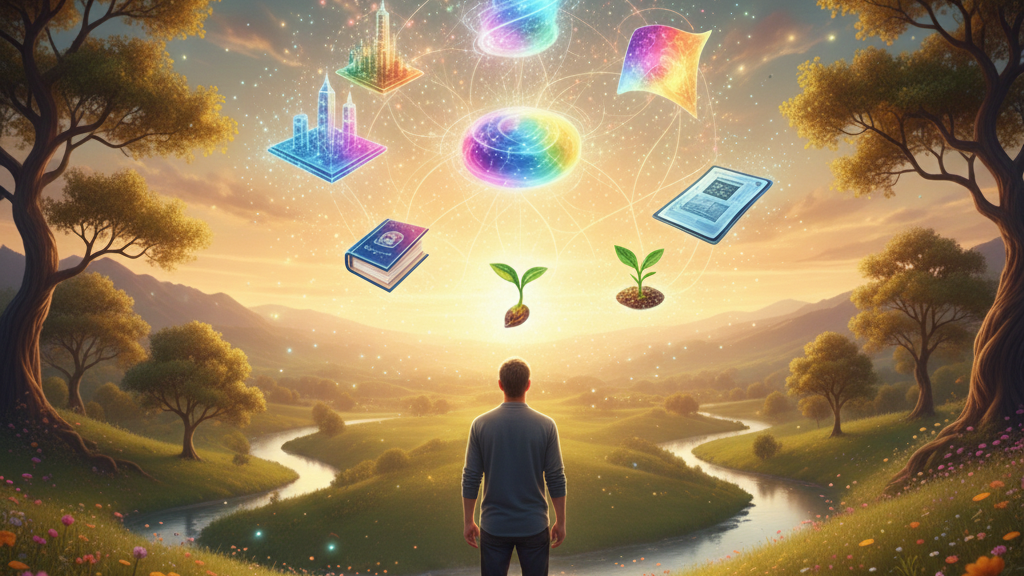
The Age-Old Problem
For most of human history, dreaming was easy. Execution was not.
People have always carried brilliant ideas inside them—stories, products, systems, businesses, and art. But between imagination and reality stood massive friction: time, money, skills, teams, and permission.
So, most dreams stayed exactly where they were born. Unexpressed. Unbuilt. Unshared.
AI changes that. It is fundamentally collapsing the distance between thinking and doing.
The Shift We’re Underestimating
We often talk about AI in terms of mere productivity: Faster design mockups. Faster code. Faster analysis.
But that’s not the real shift. What’s happening is deeper and more human: the friction that kept imagination stuck is dissolving.
For the first time, a single individual can:
- Explore ideas without waiting for experts.
- Prototype without needing large teams.
- Create without mastering every technical tool first.
AI doesn’t replace imagination. It removes the friction that kept imagination stuck.
The Translation Problem
Dreaming was never the problem. Humans have always been creative. The problem was translation.
Execution lived behind gates—technical, financial, institutional. You could easily imagine:
A revolutionary product, but not code it. A captivating story, but not publish it. A complex company structure, but not prototype it.
AI breaks many of those gates. Not by doing the dreaming for us, but by helping us move from raw thought to tangible form.
AI Is Not the Dreamer (A Critical Distinction)
This is important to say clearly. AI does not create meaning. AI does not feel curiosity. Humans do.
AI’s power lies elsewhere. Think of it not as a creator, but as a dynamic co-pilot for imagination.
Here are AI’s true roles in the creative process:
- The Translator: Turns rough thoughts into coherent structure.
- The Structure: Organizes scattered ideas into workable form.
- The Co-Pilot: Provides a safe space to try and iterate quickly.
The dream is still human. The acceleration is artificial.
Why Permission Trumps Speed
The biggest impact of AI isn’t efficiency. It’s permission.
It’s the newfound permission to:
- Start before you’re “ready.”
- Try bold ideas without fear of massive failure or cost.
- Learn by building instead of waiting for instruction.
This matters most to the people who:
- Think deeply but quietly.
- Have great ideas but lacked the technical tools.
- Were excluded from traditional, gatekept systems.
AI dramatically lowers the cost of beginning. And beginning is often the hardest part.
The New Equation
Before AI, turning dreams into reality required immense effort and capital:
Dream × Resources × Time × Team
Now, the equation is simpler and more personal:
Dream × Curiosity × Iteration
This doesn’t mean effort disappears. It means possibility appears sooner.
Welcome to the Paradise
We didn’t enter the age of artificial intelligence. We entered an age where:
- Thinking can be externalized.
- Creativity can be tested, not just imagined.
- Dreamers finally have leverage.
Dreams were never scarce. Execution was. AI doesn’t give us better dreams. It gives our existing dreams a clear path forward.
Welcome to the Dreamer’s Paradise.